content top round

Build or Sell Furniture Plans

There are really many things you can do with your completed woodworking furniture plan:

Build the project
Sell the project
Share the project

Build

Since you’ve reviewed your plan many many times, this step should be very easy to implement.  The key to start building your own furniture is to plan ahead before you start cutting.  So go through your materials list again, purchase all the materials for the project, and now double check each piece.  The point here is to look for imperfections (such as knots in the plywood) that would be in the way in the final design.  Decide which side you want facing which direction (for a table top, you may want to not see the knots, so use the clear side for the top of the table).  Look at the grain and direction of the grain and how that plays into the project.  Now figure out if its best to stain or paint the pieces before cutting, after. 

Make sure you have what you need:  clamps, hammer, screwdriver, square, etc. There’s nothing worse than getting through a step at 3AM and realizing you can’t go any further because you don’t have enough clamps!  Do you need sawhorses set up?  Do you need to lay plastic out to keep your other furniture clean?  If you’re building out in the dorm parking lot is it going to rain?  When you paint and finish the project, is there anything you need to do (like move the piece to a dust free environment)?

Now build it!  You’ve been waiting for a long time!!

Sell

This section could be incredibly long, and I’m no expert on it.  I’m going to describe what I’ve done to make Plan Canvas’s online store, but take it as an example not the answer.  My first want of Plan Canvas was to make sure that it was as free from maintenance as possible, and as free as possible.  So I researched a ton of free online ecommerce shopping carts that supported downloadable products.  The search got to one final solution four years ago:  oscommerce.  This is a good solid cart, but has an incredibly steep learning curve.  I finally found a great book by Packt called “Building Online Stores with OsCommerce - Professional Edition”.  I could have saved hours to get the store up had I bought this book earlier.

I’m not going to go into detail here, but there are many steps (I’ll share them in a future post).  But the short list is:  Read the OsCommerce book, develop your site on your computer, get a web hosting package, add content.

Once your content is added, I’d suggest working on SEO - the Thirty Day Challenge is a great place for this!  There are plenty of internet marketing courses and books, but the Thirty Day Challenge is FREE and has really helped me understand some concepts I didn’t even know existed.

This was just the way I had attacked the problem.  There are many more solutions - please leave a comment if you have any suggestions!!!

Share

The nice thing about online furniture plans is that they are easily sent over email.  They can also be posted on a website, or even printed and mailed!  The one area I haven’t looked into yet is making them a torrent.  I don’t know much about these, but essentially its a Napster for all types of files - share among others directly.  I’m certainly not for pirating, but if you want to share your work for free to others, this would probably be a good start.

Summary

I really appreciate you going through this series - hopefully I’ve given some experience and knowledge to those who are looking for it.  I’m very open to suggestions, so please leave a comment!  I’m also hoping that you enjoyed some of the insight to Plan Canvas and the furniture plans there, so if you could be kind and let people know about the store, I would be very grateful!  So please take your time and enjoy this - hopefully it will become a great new hobby!

Bookmark and Share


Publish

The purpose of going through this step really depends on what you intend to do with your furniture plans.  If you’re planning on distributing them (since they do make a great gift), this will allow others to easily build furniture without having to try to interpret random drawings.  The quality of the plans also depends on what you’re intending on doing with them, and what your own standards are.

For the purpose of this post, we’ll go through the process that Plan Canvas goes through to publish a plan.  Here are the basic steps:

  1. Go over again the way the pieces are cut out
  2. Go over again on how the parts are going to be assembled
  3. Get overall dimensions of the project
  4. Make a materials list
  5. Figure out the best way to tell the story
  6. Add in any tips you may have


Step 1)  You’ve already done this (2 times I think?), but it never hurts to go over it again before actually cutting wood.  There’s always a Doh! if you cut wood wrong and end up wasting materials.

Step 2)  If you design something you can’t build, then it doesn’t do any good.  So make sure that it can be assembled once again (prototype if necessary).

Step 3)  If someone else is building this, they may want to see how it will fit with the room and the rest of their furniture.  Also, if you’ve made your piece larger or smaller than a standard piece, people should know.

Step 4)  This is really important since people rarely want to go to the store more than once, or they may need to budget out what to buy when.  List out the tools needed too - or alternative tools if there’s another way to do the same task with a different tool.  People always want to buy tools - their cool - but if you’re only going to use it once, it doesn’t make sense to buy it.

Step 5)  Think of your audience.  Will a master carpenter be building the piece, a hobby woodworker, or a college student who used a jig saw once in wood class back in junior high.  If its the latter, be sure to really explain each step.  Don’t assume that the user will know exactly what to do for each step.

Step 6)  This part is totally optional, but if you have anything to add from your own experience, add it in.  As people begin to work with building things, the more tips they have, the more comfortable they will be building projects in the future.

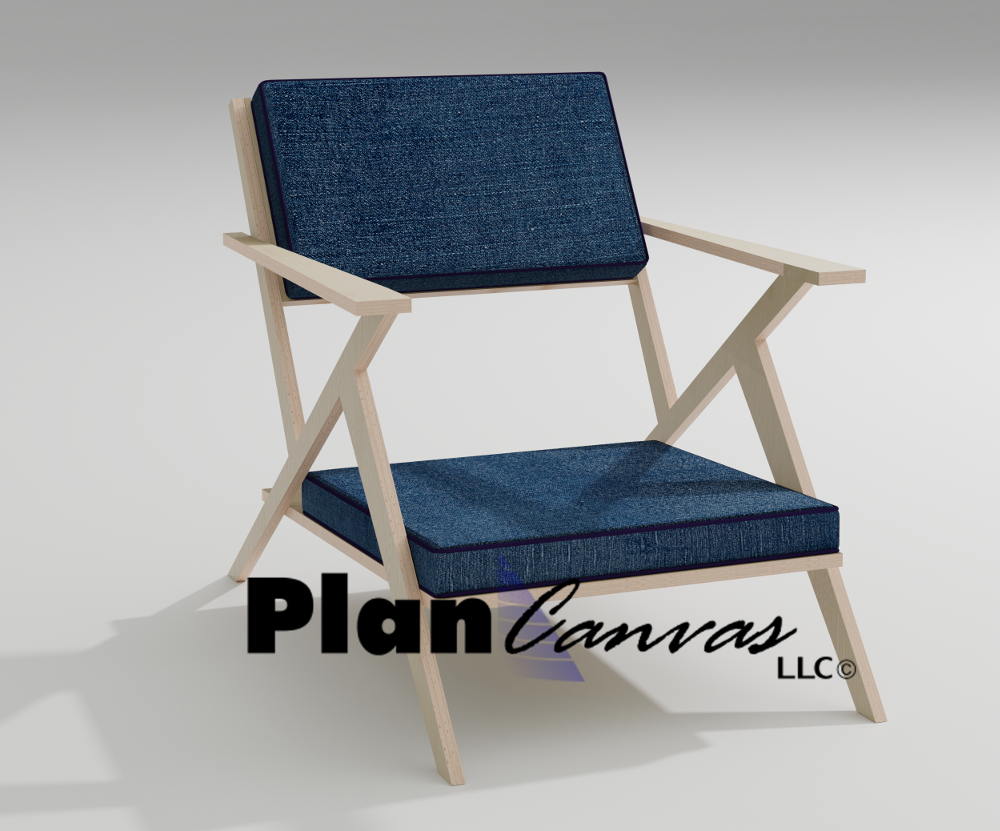
So as a very special example, the Plan Canvas Chair 00004 furniture plan will be free for you to use to understand where we are to this point.

Bookmark and Share


Rough Draft

Even if you’re doing a one-off piece of furniture, or making a small set, it is very good practice to put your drawing and method of assembly on paper.  The reasons are pretty basic:

1)  If you’re ever going to build another one, lots of little intricacies may be detailed here.
2)  If you’re going to share the plans, others need to know the details on how to make it.
3)  MOST IMPORTANT - Writing down the furniture plan makes sure that you’ve thought through the whole process of building your project.

I can’t tell you how many times I’ve just gone off to build something without thinking it through all the way.  This creates expensive waste - so take the time to think it through.

For furniture plans, its best to start from the beginning - the materials.  Make sure that the materials you’re choosing are available, that they are the right sizes, and that they are actually what you think they are (in other words, get your hands on some real stuff before you buy it!)

The next step in the process is to write down the list of materials.  How many fasteners do you need?  How much wood, paper, glue, metal, paint, stain, tools do you need?

Then, make sure your cut diagram (from the last post), makes sense for what you’re building.  If the cut diagram isn’t right, you’ll create more waste.

Now make sure that you can actually cut it!  For example, if you have some interior cuts (like the arms of Chair 00004), you’ll need not only a jig saw, but also a drill.  If there are beveled edges, make sure you have a circular saw or table saw that can cut at angles.

The next step involves your imagination.  You have all the pieces in front of you, now put them together.  Think about how you can get them together so that they are at the angles you need (like the chair legs to the seat), and that you can assemble them (the legs on the diagonal storage table are a good example - you cant put the bottom shelf in last because the legs are already attached to the table top and can’t bow out to accept the dowels from the bottom shelf).  This is a very important step and can really change your designs if you don’t think it through!!

Finally, think of what you would want to do to finish your project.  Does it make sense to sand all sides of each piece?  Can you save time by sanding only a couple of surfaces?  Should you paint all the pieces before putting them together?  Do you need to protect some of your surfaces from damage during assembly (since wood glue soaks into the grain, stain doesn’t come out uniform where glue has soaked in - tape off areas that glue may touch to keep your finish clean).

So to sum up, the main reason for putting the furniture plan down on paper is to make sure that you’ve mentally walked through each step of making the project happen AND to catch anything you may have missed so far.  Spending time here can help save a lot of time, frustration, and money when you actually start making sawdust fly!


Practicality

Most of us don’t like spending more on a piece of furniture than we need to.  So the key to utilizing the materials at hand is what I call practicality.  This is where your concept was refined by theory, and now your design is modified through practicality.  This is where your inner engineer comes out.

The key to using all of your material is very practical.  Ant the key to this is to continue to refine your design to use all the material.  Most furniture plans out there have a good idea of how to do this, but since you most likely don’t design furniture for a hobby, I’ll let you know some of my secrets to making this work.

Most of the furniture plans on Plan Canvas are built using 3/4″ thick plywood.  Most plywood comes in sheets of 4′ by 8′, or 48″ by 96″.  Also note that some of the plywood available has dings in the edges, or is not cut perfectly to the “4×8″, being a half inch too short.  The importance of all of this is that when you’re laying out the parts to cut on the plywood, the part cannot be longer than say 95″ or wider than 47″.  This gives us just a little room to make up for a bad piece of wood.

One little note here.  I’m not a big fan of MDF for furniture making, specifically if the furniture will be used outside, or if you’re building a table where it will continuously see condensation.  The reason here is that MDF is Medium Density Fiberboard.  Fibers are taken, compressed, injected with glue, heated, and finished.  This is a great use of material that would otherwise be thrown away, but it is not as strong as plywood, nor is it as able to withstand long exposure to the elements.  Plywood, on the other hand, is made up of sheets of wood.  The grains are alternating, which means that it is very strong in all directions.  It can be harder to finish though; it depends on what grade of plywood you purchase.  I’ll try to do a special posting on materials, as they are incredibly important in the design.  I’m also very open to comments here, so please feel free to add them!!

OK, so now on to the bigger steps.  For the furniture plan for Chair 00004, I had drawn out a basic design of the chair in TurboCAD.  I also made some measurements.  What I found was that all the parts for the chair could be laid out on a half a sheet of 4×8 plywood.  This is huge!!  Two of these modern chairs can be built from one piece of plywood!  The downside was that there was some wasted wood.  There will always be wasted wood (well, almost always).  The key is to make as little waste as possible.

Now there are two methods here.  The 21st century method of using CAD software, or the inexpensive method of using paper cutouts of what you’re building.

An example of what I did in TurboCAD is below.  I sketched out the design in CAD, then moved the parts around on a 4×4′ shape.  I moved them until they were both easy to cut, and easy to measure out.  Below is Chair 00004 in its final layout on plywood:


An example of what you can do on paper is also easy, it just takes more time.  Draw out your pieces on a piece of paper (do this to scale, so 1/8″ on your cutouts is equal to 1″ in real life) and cut them out.  Then on another piece of paper, draw out a square to represent the plywood, and start moving your cutouts around until they fit the plywood box most efficiently. 

No matter which way you do it, what you may find is that there needs to be some changes to the sizes of your pieces to make them fit right.  So make the changes in size, redraw your design with the new sizes, and see if it works.  If it doesn’t work well at all, use more wood.  I hate this alternative, because it goes against building modern furniture for cheap, but it does allow your design to be built as you want it.

Try and try again.  This part can take some time, since you’re continuously going back and forth between your design, the theory, and the material at hand.

Once you’ve laid them out to where you feel comfortable, and are using the amount of materials you want, then its off to the next stage - rough draft.

Bookmark and Share


Prototypes

This next step can be a breeze, but make sure that you’ve spent due time on the last step - theory.

The reason why the theory part is so important is simple - waste.  If the theory behind your design isn’t quite complete or thought through, you may end up building something that really won’t be of any use.  Now this does not mean that the prototype will have an aura of greatness about it - its a prototype!  It will be ugly, multicolored, unfinished, snarly, and it will also prove to you that your theory is good and areas that need improvement.  Most importantly though, it gives you the confidence to move on to the next steps.

There are so many ways to go about proving to yourself that your theory is sound.  If you’re designing something that is similar in function to something that already exists (in size, main dimensions, weight, etc.), use that as your starting point.  For example, Plan Canvas’s Chair 00006 is a set of two bar stools that can be made from plywood.  The prototype for these stools was actually an existing shop stool that had the same outer locations for the feet, and the same height of the seat.  I then double checked the size of the seat by cutting up a piece of scrap wood and sat on it!  I didn’t want to make a seat that was too small; nobody would ever sit on something uncomfortable!!

On Chair 00002, I didn’t know if the back of the chair would be stable or not if someone leaned up against it.  I have a mechanical engineering background, so I ran some numbers using MathCAD and found that the design could have 200 lbs pushing on it and deflect less than a 1/16″.  So I had convinced myself that it was a good design before even building a prototype (and wasting time and material).

For Table 00003, I didn’t know if it could be a table AND a chair, so I built a prototype and sat on it.  Works great!

Another example of a prototype was for Chair 00004 - the main focal point of this series.  I originally didn’t design in cross braces for the legs.  I didn’t want them.  They didn’t look like they fit in the design.  But I wasn’t sure.  So I built up the bottom half of the chair from some wood and tried it out (see the picture below).  It didn’t work.Chair 00004 Prototype - Braces or not?

The seat was far to flimsy from side to side, and the dowels didn’t like being in a bending moment (the seat tried to bend the dowels out of the legs).  So I added cross braces to the prototype, and wammo!!  Great design (I like it better now with the braces), minimal changes to the concept, and it worked!!!

So here are some ideas for how you should run through prioritizing how to go about taking your design through the prototype stage:

Goal - A prototype will allow you to have confidence in your design and allow you to make your final design that will work and look right

  • Step 1 - Look at your design and based on your experience, look for areas that you question for either function or appearance
  • Step 2 - Figure out what you can build to mimic this area of concern - use only as much as you need, you may not need to build the whole thing
  • Step 3 - Build up your prototype.  Spend just enough time to prove out your function or appearance
  • Step 4 - Take note - With your prototype if front of you, make sure you take note of everything of value from it.  Mess with it, look at it, tip it over, whatever.  Use it and note important aspects of it!
  • Step 5 - Implement it - Refine your concept to incorporate what you’ve learned.  This is pretty important as we set up for the next steps.  Keep in mind sizes of parts, how many you really need, how to fasten them together, will you be able to assemble it, etc.


This part is really fun, since your concept (or part of it) will see the light of reality!  A little bit of your creation in the real world.  Remember - the prototype has value only if you learn from it!

The next portion of the series is practicality - how to achieve your desired piece while using as little material as possible!

Bookmark and Share


Theory -

The third step of the process is to actually take your concept to something that retains your design concept, but also makes it something that will actually work and be comfortable. Although the concept part of the project can be considered art, this next step is also art since you have to balance what you want to see versus what you want to feel - a huge task!!

Throughout my designs, the most important part of a good piece of furniture is to have it function as it is supposed to. For lots of modern furniture, this can be very difficult to achieve since many of the planes and lines of the furniture are so flat or at acute angles. The other neat thing here is that you can size the furniture to fit your size. In my case, I’m about 6′1″, so smallish furniture isn’t really comfortable. I tend to size up chairs and tables to better fit my frame (for example, Chair 00003 is a bit over sized, but fits perfect!).

Lots of the theory you can take from most public furniture, like the library, or from around your house. For Chair 00004, I used our breakfast nook chairs I bought from Pier 1 (obviously before I got into modern furniture design!!). These chairs had great proportions, but didn’t look as nice as I would have liked - but they work.

The other thing to think about is where your body actually touches the chair - the seat, the backrest, the arms, and where your feet will land (unless you like to dangle). The other other thing is what is the chair going to be used for?? There is lots to go into here…

Seat Height - Now think about how the location of the seat to the floor plays a role. If the seat is too close to the floor, your knees are higher, and off the front of the seat, or your legs fold back under the seat. If the seat is to far from the floor, your thighs end up getting cut into by the forward edge of the seat. So in my case, I like a seat high enough so that the length of the seat equally supports the length of my thighs. As a general rule, a seat height of 14″ to 18″ works for me.

Seat Angle - OK, if you were raised like I was, a church pew is nothing comfortable. The seat is perfectly horizontal, and the back is at a right angle (we’ll get into that in a second). The opposite of that is sitting in a folding chair that isn’t locked, so it folds on you. About 5 to 15 degrees from front to rear works just fine depending on what you want the chair used for. If its a dining room chair, generally you sit up pretty straight, so 5 degrees works well. If you’re lounging around, the 15 degree works really well…

Seat Width and Length - I like wide chairs and I cannot lie. No other… ANYWAY, wide chairs give you more sitting options especially on chairs with arms and while using a footrest. My breakfast nook chairs are about 18″ wide, which is ok. Chair 00004 is 20″ wide. The length of the seat is also a pretty big deal - if it is too short, your thighs aren’t supported. Too long, and your back will never touch the back of the chair. I like anywhere from 14″ to 20″.

Back Angle - Like in the church pew example, a right angled seat back is great if you don’t want to be comfortable… An angle of 5 to 15 degrees relative to the seat angle works here too and for the same conditions. So if you want to sit up straight, make the angle 5 degrees relative to the seat angle. Increase the angle for more lougedness.

Back Length - What is the chair going to be used for? If its a lounge chair, or a chair at a bench or bar, a low back is great to leave your upper body free. If you have a high-backed chair, it is more confining, but it also allows you to lean back all the way and be supported. For low backs, 12″ is the max - it is high enough to support the small of your back, but not high enough to hinder movement. For a high backed chair, the ceiling is the limit (unless the chair is used outside). Remember though, your back and head isn’t straight, so if you have a straight back at a steep angle, there’s a chance that your head will always smack the back of the chair as you sit down.

Back Width - I tend to shoot for the same width as the seat - 14″ to 20″

Arms - I’m not good with arms. If they’re too low, you’ll never touch them. If they’re too high, you’re always shrugging. If they’re to far apart, you can’t reach them. If they’re too close together, you fell squeezed in. If the chair is to have arms though, around 8″ high and 3″ wide on a seat with a width of 18″ should work for most.

All in all, I’m no ergonomisist and all of what I just wrote are not any approved dimensions for a “healthy” or “regulated” or “safe” or “registered” chair design, but they work for me just fine.

So we just went through chairs, so you can imagine what its like for things like tables, sofas, bar stools, cabinets, bird houses, bread boxes, etc. Lots to consider. The key is to play around with what you can measure and what feels right to you. Measure lots of stuff and see what it is - then sit in it and see if it feels right.

Your next step is to take your concept and try to get the theory above into your concept. I can’t begin to tell you how hard this is to try to keep the proportions of your concept and push it and pull it until you get some sizes that match what is comfortable. Generally, I use the height of the seat to the floor as the main dimension to drive the rest of the design. If this one is off, you’ll never sit in your chair. If you’re into computers, a CAD system will really help here (I use TurboCAD ). If you’re not into computers, sketch your idea and use a ruler to keep things in the correct size. For example, a 1/8″ on the ruler equals 1″ in real life. Give it a whirl!

If you’re more into hands on stuff, then my suggestion is to mock stuff up in cardboard, but that’s for the next phase - prototypes.

I’m really open for comments on this one. There is so much difficulty in getting a design to something that works!
Bookmark and Share


So strangely enough, there are modern furniture plans on Ebay. I’ve added a little box on the left that continually scans Ebay for modern furniture plans for sale on Ebay. Some of the items for sale have some great scans of pages of the plans that they are selling.

Even if there isn’t something you find that you want, a lot of the pictures of the finished products can serve as some great inspiration for designs of your own!

Where do you find inspiration?


Concept -

Now is time for the creative part!!

Once you’ve been inspired, the next step is to use whatever you are comfortable with to sketch out what you think you would like. Don’t worry if they are all out of proportion, or don’t look quite right. This step is to really understand where you’re heading and get “that feeling” you got when you went through the inspiration stage. Even if you can’t quite get it down on paper, that’s ok, there’s no rush!

I do almost all of my conceptual work in TurboCAD, and usually skip the whole paper sketch part. This software is certainly not the end-all of what’s out there, but its pretty inexpensive and does exactly what I want it to do - we’ll get to that in a little bit. For Chair 00004, I had in mind that I wanted something with really simple lines, and arms. That was about it. I also gave some thought to what it was going to be used for - an outside chair for the front porch or for the outdoor patio. Nothing fancy, and no upholstery.

So, now go out and draw a ton of stuff! Use different angles to view what you’re trying to get. MOST OF ALL - DON’T WORRY!!! These sketches are for you and only you need to know what you’re trying to get. Its kinda like when a 5 year old gives you a piece of paper with scribbles and asks if you can see the cow…

What you’re trying to get out of this preps you for the next step - theory. The next step ties your concept to something that should be functional.
Bookmark and Share


This multiple series of how-to articles will explain how I create furniture plans for Plan Canvas and also (hopefully!!) give some answers to those who are curious.
Here’s an overview of the articles that I see fitting in:

1. Inspiration - This is the research part
2. Concept - This is the creative part
3. Theory - This is where all things need to work to make it real
4. Prototype - Make sure it works if real - all in CAD
5. Practicality - Make sure you use as little material as possible
6. Rough Draft - Putting it on paper
7. Publish - Have the Teacher work your check
8. Build and/or Sell! - This one could be a whole separate set of articles, but I’ll outline the steps on my store

So starting at the top!!

INSPIRATION

From as far back as I can remember, I’ve always enjoyed the clean lines of mid-century modern furniture. I grew up with a very good friend of mine in Iowa who lived in a very large ultra-mod house, complete with an Eames chair in the living room. The house itself was incredible, but what really got me is how the house had a style both in and out. Since I knew that the amount of money to spend just building houses was something out of my reach, I decided to start drawing up furniture that had the same feel as Mark’s house. I also drew cars, but we won’t go into my day job…

So nowadays, I tend to review lots of various modern furniture sites, along with a vast array of books. I’ve added links to these sites and some of these books on the blogroll on the right. Don’t focus on anything, just find something that you like, something that strikes a chord. Bookmark, or somehow save up these various areas of inspiration. If you keep into the area of building furniture plans, this becomes seriously helpful for your future projects.

For the purpose of this series of articles, we’re going to look through the development of Plan Canvas’s Chair 00004. This is one of the better selling furniture plans on the site, and has had some really nice reviews 1, 2 (thank you!). The inspiration for the chair was pretty simple - I needed some chairs for our front porch. I had some cheap plastic chairs that we’d junk-picked and they work great, but look horrible. I wanted to have something that looked nice, but didn’t cost an arm and a leg. At the end of this, you’ll see that I ended up designing a chair that can be made from half a sheet of 3/4 inch plywood.

So take your time and browse through some of the links, look on Ebay, search Craigslist, go to your local “antique” shop (Detroit has lots of these) and pick out some pieces that really hit you!!!


Bookmark and Share


Building furniture plans, or doing any woodworking, means at some point you need to cut straight edges. My rule for choosing the right tool to cut with depends on the length and type of cut. If the cut is to be a straight cut for more than a few inches on an edge, the circular saw is the only way to go. It cuts far faster than a jigsaw, and doesn’t change angle very quick as you’re pushing it along. If the cut is curved or only a few inches, I’d go for the jigsaw because it is easy to maneuver and gives a clean edge. I would mention table saws here, but they are quite expensive for the occasional woodworker.

This post deals with cutting straight edges using a circular saw. In my experience, I would much rather cut really long pieces (like over 3 feet) with a circular saw rather than a table saw - its much easier to handle a small circular saw rather than a huge piece of board! The choice of buying a circular saw is outside the scope of this post, but many resources are available online.

The easiest way to cut straight is to clamp on a straight edge of some sort. I like to use extruded aluminum from some door framing (I found some in my basement), or use the machined edge of a piece of plywood, or even a piece of dimensioned lumber like a 2×4. The key of using anything is how straight the piece is, and where it is clamped to the workpiece. How straight the piece is depends on what you’re using. Where you clamp it is what the rest of this post will discuss.

For either a circular saw or a jigsaw, the critical measurement is the distance between the edge of the base plate and the end of the cut from the blade (see fig 1 and 2 below). This is the distance you need to clamp the inside edge of your straight guide. The fastest and most accurate way to measure this distance is to take a piece of scrap wood and cut it with the circular saw, and measuring where the edge of the base plate is to the edge of the cut. Take your time here.

Figure 1

Figure 2

Now using the same piece of scrap wood, try clamping on your guide, measured off a line you want to cut to. Take a cut and see how accurate you were. That’s it!

There are quite a few different guides on the market, but this way is far cheaper and great if you’re just getting into woodworking, or don’t have much coin. The main point to remember is that clamping wrongly will cost you in extra materials in the end.


Bookmark and Share


ad 300px

Recent comments